Dr Oishee Kundu wanted to create a simple card game to get students discussing inequality. What emerged is a thought-provoking exercise in highlighting complex issues.

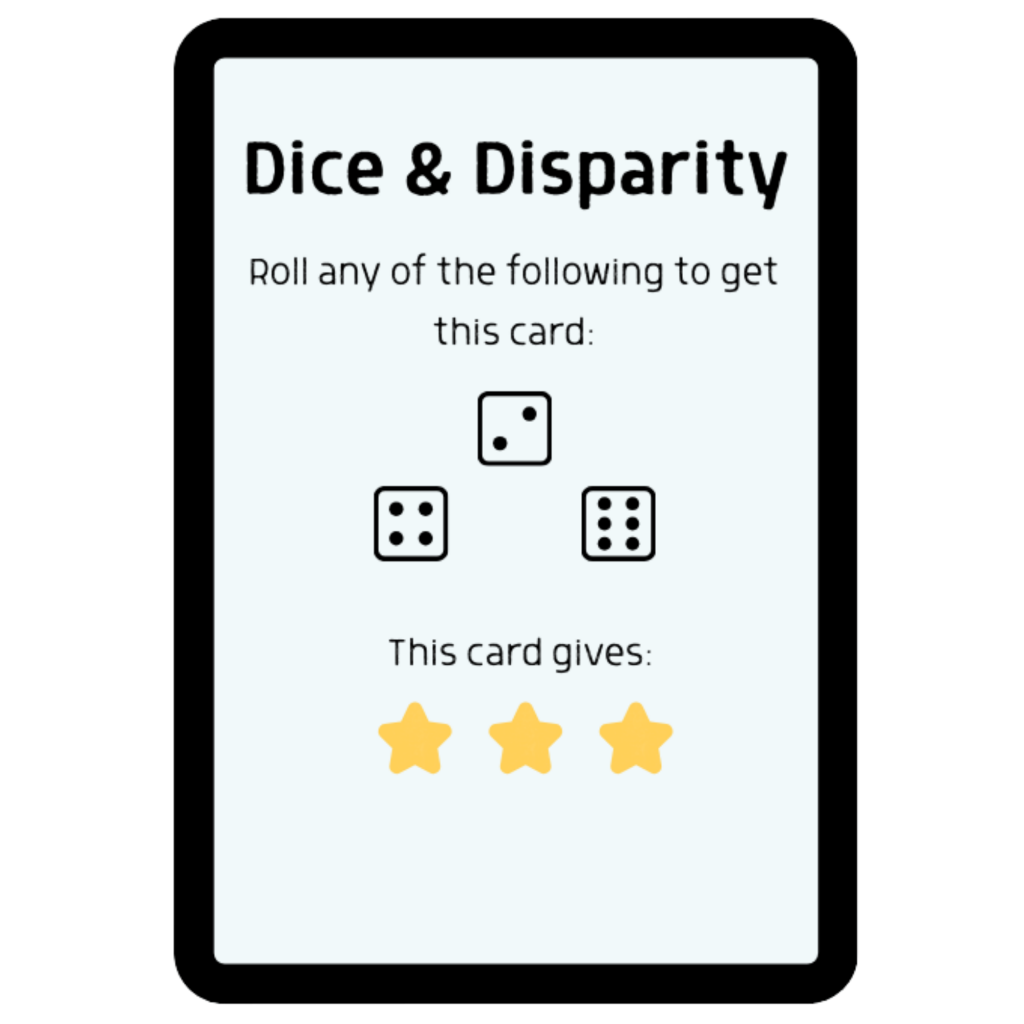
You have two cards in front of you – one which you can gain by rolling a 2, 3, 4 or a 6 on a dice and the other which you can gain only if you roll 1. You decide to bet on the first card – there are more chances of getting it after all. The dice rolls to a 4, you get your card, and you are happy. Your opponent on the other hand now must try and roll 1 to get the other card. And then the game heats up – who can get a 1 first? After a few attempts, your opponent manages to get the card. Both of you now flip your cards and find out your fate:
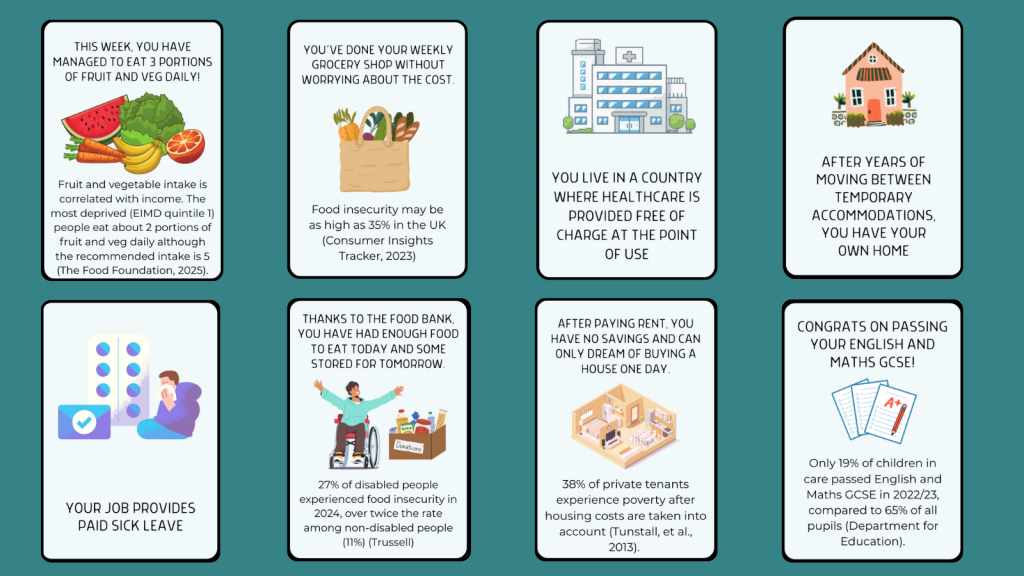
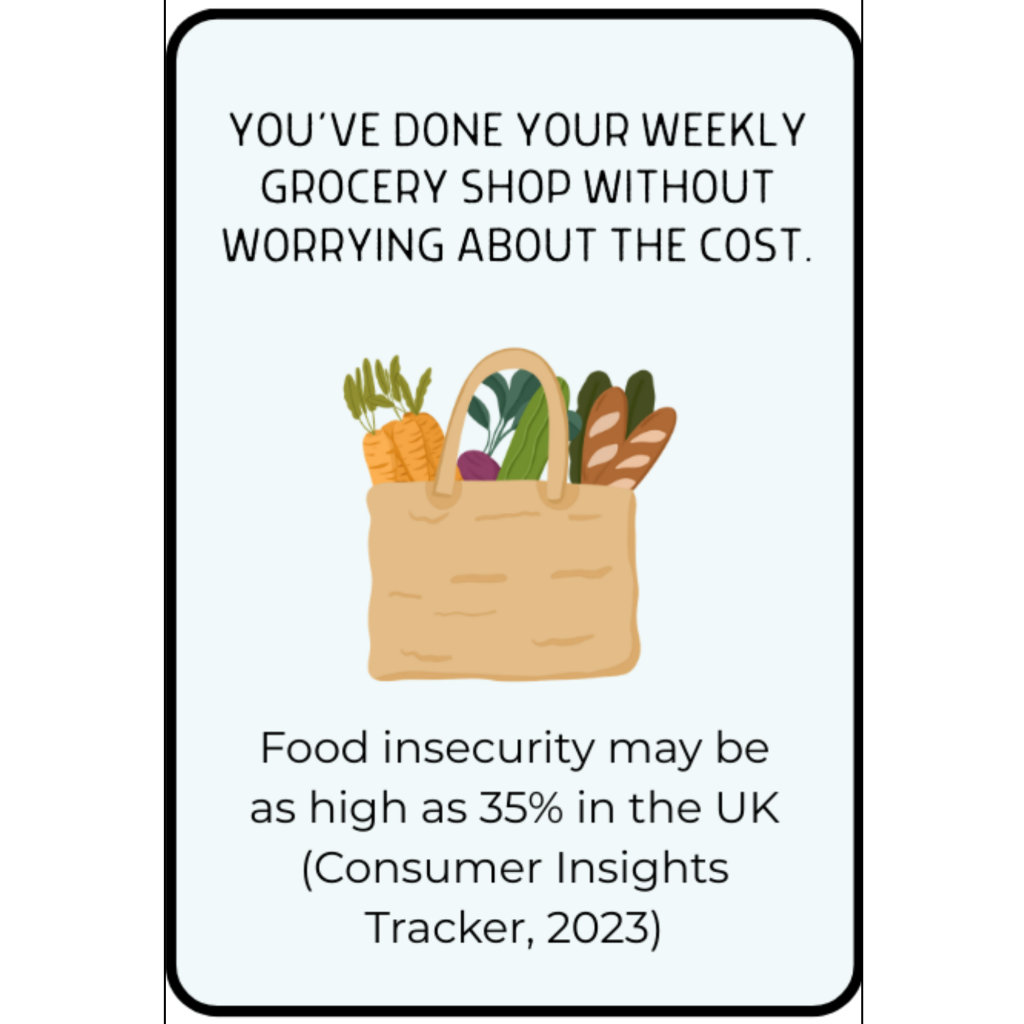
Your card: A cheerful clipart of a grocery bag filled with fruits and vegetables. ‘You’ve done your weekly grocery shop without worrying about the cost.‘ Your opponent: A person in a wheelchair next to a basket of food. ‘Thanks to the food bank, you have some food for the next few days. 27% of disabled people experienced food insecurity in the UK in 2024, over twice the rate among non-disabled people.‘ You have both got a card each, and you did get your card first, but who has won the game?
‘I have always found it incredible how games have the power of revealing a player’s inherent beliefs and biases and therefore, using the game to allow students to learn more about each other seemed like a gentle way to initiate conversations.‘
I created Dice and Disparity for the Social Science and Social Issues module taught to first-year students at Cardiff University by Dr Honor Young. Students on the course learn about the theories and debates in social sciences about sources and causes of inequality, how inequality is experienced by different demographic groups, and most importantly, how to work together as a group to deliver a project where they map inequality for a specific area in Cardiff. The original motivation for the game was to get students talking to each other about inequality – the game as a conversation starter – and for them to get to know each other for the group work. I have always found it incredible how games have the power of revealing a player’s inherent beliefs and biases and therefore, using the game to allow students to learn more about each other seemed like a gentle way to initiate conversations.
However, in the process of developing the game, I began to see the dice as ‘the system’ and realised that the game has much to say about the way systemic inequality can be observed in our societies. The game shows how some people have a much harder time getting basic things like enough food, having a safe place to sleep, or passing exams. This is not because they don’t try, but because the ‘system’ (the dice) gives them fewer chances. That’s why, in the game, you sometimes have to roll a special number to get certain cards, making them harder to get, while other cards are much easier.
‘The game shows how some people have a much harder time getting basic things like enough food, having a safe place to sleep, or passing exams. This is not because they don’t try, but because the ‘system’ (the dice) gives them fewer chances.’
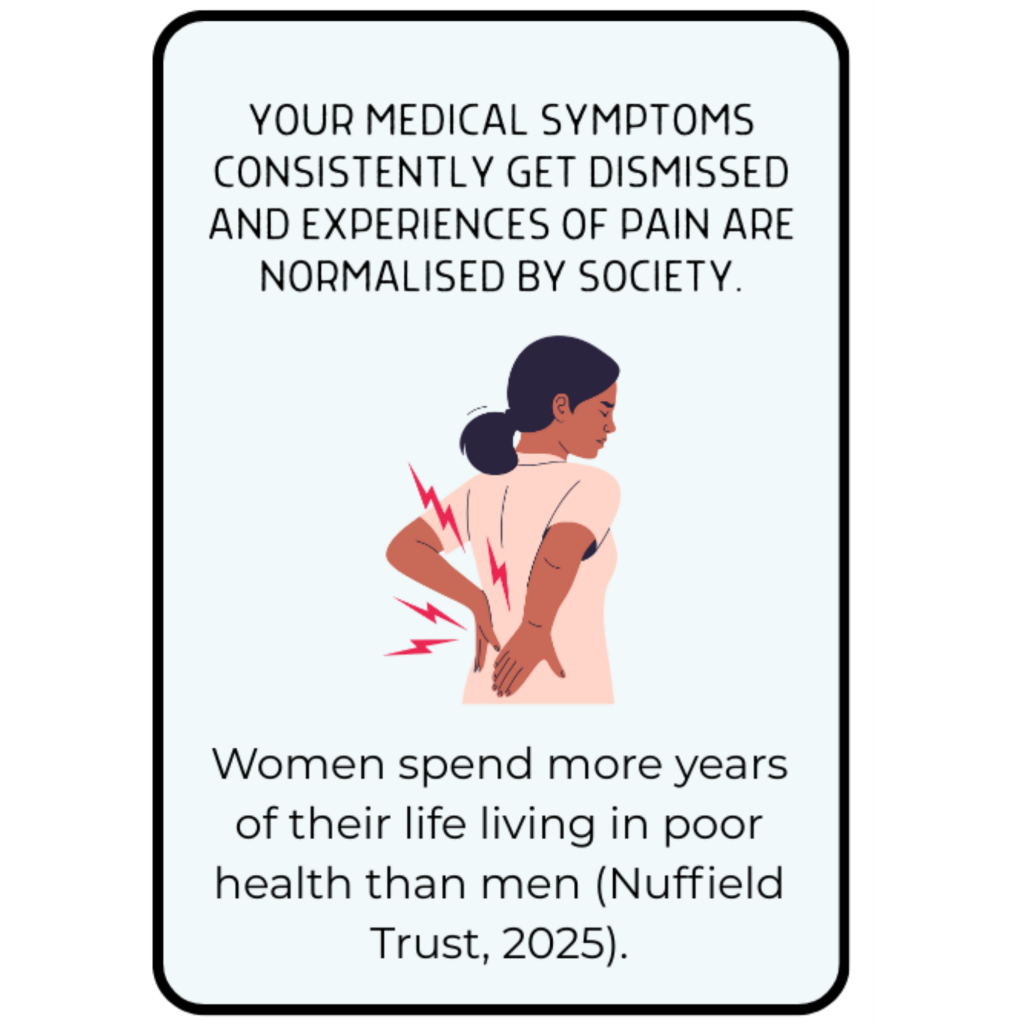
Dice and Disparity is not the first game I developed, but it was the first game that made me cry in the development process, because reading up some of the statistics about educational and health inequalities stopped me in my tracks. What a horrid world we live in, and how easy it is to fall foul of ‘the system’! Gender, ethnicity, physical and mental health conditions, family income and whether you have a stable household or not – all go on to contribute to the life you experience. Rolling dice makes it seem like milestones in life are luck-based rather than based on your efforts and merits, but that is exactly the argument made (in many more words) in The Tyranny of Merit by the philosopher Michael Sandel.
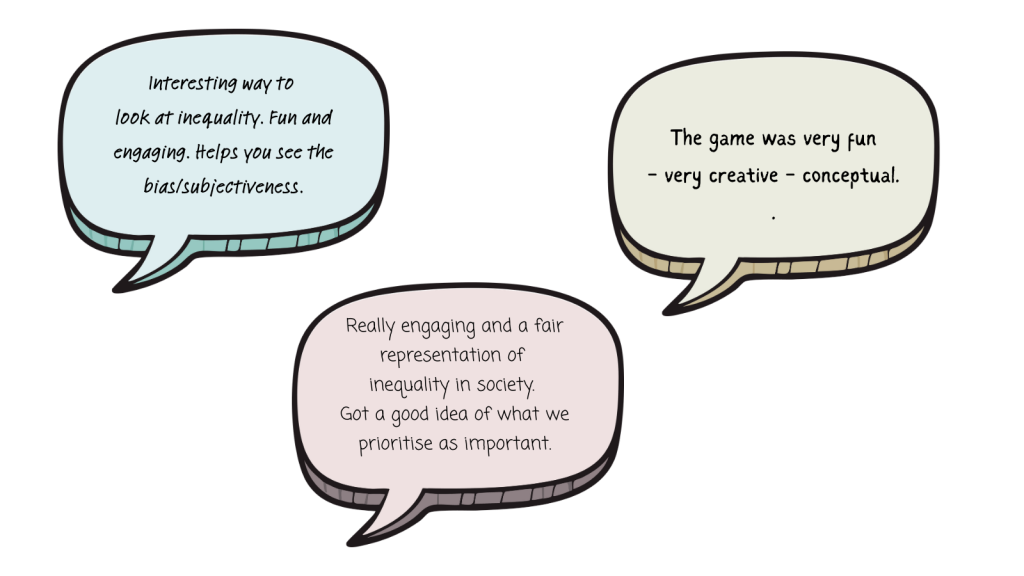
On a cold and rainy February afternoon, 22 students played the game. It takes five minutes to set up (or less) and within 15 minutes of getting started, I was really pleased with the reflections that were coming in. I asked the students if they would like to give ‘stars’ or points to cards. Most groups struggled to come to a consensus about it, and the results that emerged were varied. Overall, there was a weak negative correlation between the difficulty of getting a card and the number of stars it was worth, which perhaps reflects the differences in values and priorities among different people (see figure below for comments from players).
‘Dice and Disparity is not the first game I developed, but it was the first game that made me cry in the development process, because reading up some of the statistics about educational and health inequalities stopped me in my tracks.’
And perhaps that is the use case for the game going forward – identify and prioritise social issues in communities, build consensus, and allocate resources to tackle complex challenges without getting paralysed by complexity. It may seem trivialising to use a game, childish even, to which I always argue back that games convey ‘childness‘. Childness refers to the dynamic, imaginative, experimental, and curious part of our selves that is highly pronounced in childhood but may get subdued over time as we grow older. Bringing play into learning and research environments allows us to bring back those qualities that may have faded but are still inherently present in all of us!
Would you like to play?
If you would like more information on the game, or to try it for yourself, Oishee can be reached at KunduO@cardiff.ac.uk.