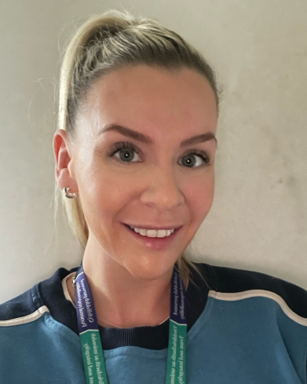
Sara James is a Clinical Lead Physiotherapist and Health and Care Research Wales Emerging Research Holder. Here, she shares her experience of the DECIPHer short course.
In June 2026 I was fortunate to attend the five-day DECIPHer course Methodological Innovation in Public Health Intervention Science: Development, Evaluation, Adaptation and Implementation. I am relatively early into my research career, having completed a feasibility study into understanding the impact of waiting for access to musculoskeletal outpatients therapy services, via a previous RCBC Wales First into Research (FiR) Fellowship. I am currently planning a doctoral study exploring the topic of Wales-wide access to these services with the support of a Health and Care Research Wales Emerging Researcher Award.
I consider myself a keen novice in the research world. However, I do know that I want to influence positive and meaningful system change by understanding and implementing change, and understanding whether that change improved the situation. I want to learn about what needs to be changed on the ground, in my role as a Clinical Lead Physiotherapist. I hope that, in doing so, I contribute to bridging the gap between clinical practice and academia. I was therefore keen to learn about implementation science, but I could never have guessed how attending this course would transform my thinking and doing.
First impressions
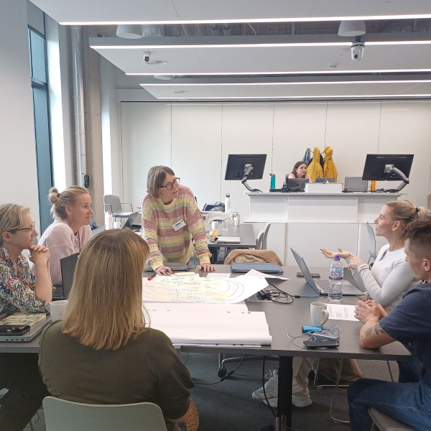
I arrived bright eyed on Monday, coffee in hand and ready to learn. I was probably the least experienced researcher there, which made me a bit anxious. But the first day’s overview of the subject, interspersed with breakout discussions and brainstorming, quickly helped me to realise that while I have a lot to learn, I also have something to give. Tuesday to Friday’s sessions were organised systematically so that each part of the process, from planning to evaluation, was delved into deeper, sequentially, helping us to familiarise with the process.
’47 (yes, 47!) pages of notes and folders upon folders of rigorous research articles downloaded later, I feel like the legacy of this course lives on in my brain and on my desktop.’
Every one of the speakers here was inspirational and demonstrated both clear aptitude in academia but also humility in their success and achievements; and they were human! I took on board everything that I possibly could from each one, and 47 (yes, 47!) pages of notes and folders upon folders of rigorous research articles downloaded later, I feel like the legacy of this course lives on in my brain and on my desktop. My notes remain open on my laptop, ready to share with anyone who may benefit from hearing. This includes my Service Lead in NHS Wales, who now knows how logic models and causative mapping may also serve to inform planning of service level projects. I have even shared my learning with my husband, who has learned how to demonstrate value, beyond cost per hour, in plumbing (thank you, health economics module).
Thinking = transformed
As I mentioned, I am currently working on an application for a doctoral study. My application prior to this course lacked granular detail and clarity in what and how I would answer the research question. Following this course, I have developed three packages of rigorous study, underpinned by theoretical constructs which have been informed through patient and public involvement. Each package sets out to answer clearly defined aims, robustly and systematically, and have a clear end point; easier for the reader to appreciate through the use of supplementary logic models. Previously designed methods have been transformed to consider what I now know about the complexity of data linkage. Before this course, I just about had a basic understanding of some of these intricacies and had never heard of others. So, yes, I had a lot to learn, but this course enabled me to do so.
One of the most impressive things about this course is that, no matter where someone seemed to be on their career trajectory, they found value in attending. There were delegates with 30 years of experience in the room enthusiastically writing notes or frequently asking questions in order to better their grasp of what was being shared. I felt like the whole group of speakers were my friends by the end of the week, and between this and the friendships made with the other delegates, I felt part of a community. I actually had the blues afterwards and wanted to go back!
Final takeaways
Whilst much of the detailed content will undoubtedly prove more valuable as my research develops over the coming years (note to self – back up my notes), I would strongly recommend the course to anyone involved in research, including those who are early in their academic journey. I am currently on a productivity peak, motivated by what I have learned. However, it is not just the resulting volume of my outputs that is valuable, but the fact that I now understand how rigorous planning, implementation and evaluation fit together within the larger process of intervention development and research delivery: We have to know where we are to know where we are going. And, whilst there were, and still are, moments where I think ‘Why don’t I just leave this to the people that are good at doing it’, there are also moments where I think ‘You’re managing to make this make sense, Sara’ – and that is an entirely different place to where I was before this learning experience.
‘I would strongly recommend the course to anyone involved in research, including those who are early in their academic journey. I am currently on a productivity peak, motivated by what I have learned.’
If you are thinking of attending this course, think no further – apply. It doesn’t matter where you are in your career or what you are hoping to achieve, the DECIPHer short course can help to get you there. You will meet so many like-minded people, you will have fun whilst learning, and the learning will continue far beyond the week that you are in the room. Thank you DECIPHer, I am beyond grateful.
Find out more about the short courses here: DECIPHer short courses.